
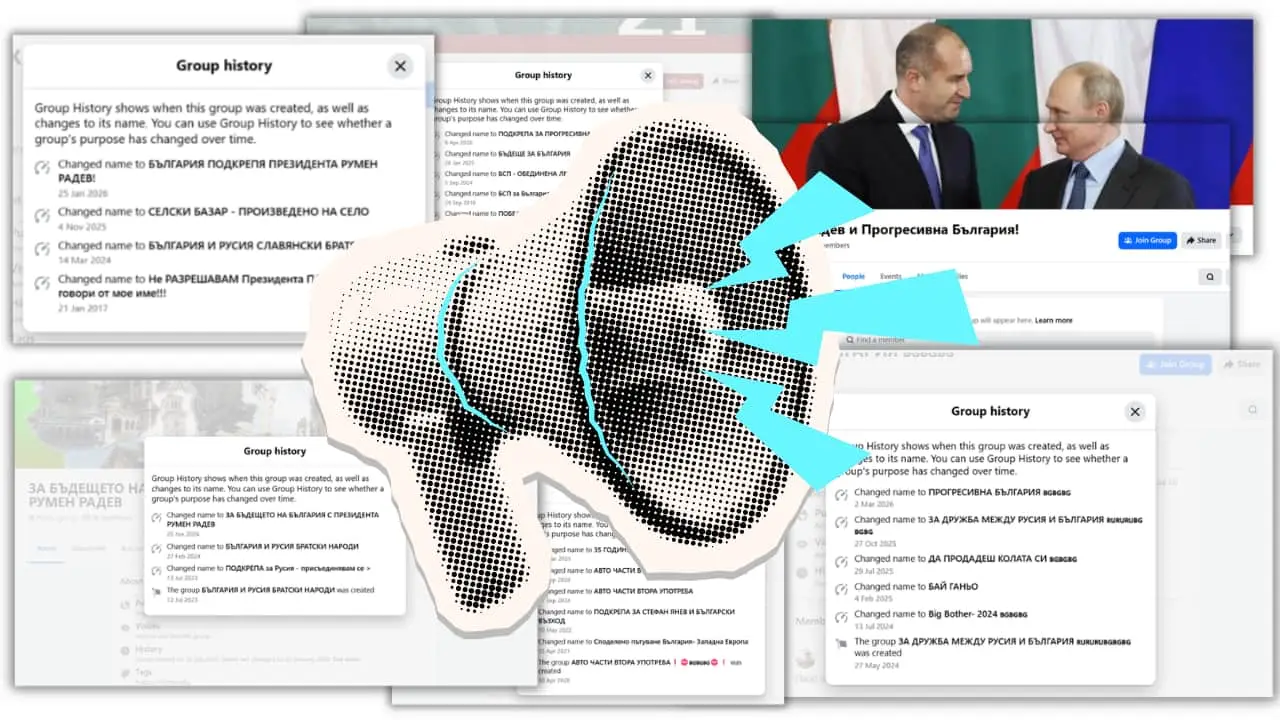
After 9 years as president of Bulgaria, Rumen Radev won the parliamentary elections on 19th April 2026 and will be the next prime minister of the country. The election campaign of his party Progressive Bulgaria was one of the most expensive in the history of Bulgarian politics, if not the most expensive one. And while Radev refused to participate in debates, his messages travelled wide and far thanks to the internet.
Facebook is the most widely used social network in Bulgaria. During the campaign, several online media outlets have raised questions about the fact that a number of Facebook groups with large followings have recently changed their names and stated purposes, transforming into highly active hubs supporting Rumen Radev and Progressive Bulgaria.
While this may simply reflect a shift in the political preferences of the groups’ administrators, or their desire to grow audiences by aligning with prevailing public trends, it also suggests that thousands of users may have been receiving regular notifications related to Radev’s political campaign without fully understanding why.
Moreover, the presence of numerous large, consistently active groups can signal credibility and may influence undecided voters. Further to that, users who engage with the content in the repurposed groups, even if they joined them with a different aim, could be recommended more Radev-related content and groups by the algorithm.
I spent hours reviewing Facebook groups linked to Radev and Progressive Bulgaria, because I wanted to find out if there was a pattern to how they worked, and I observed the following:
- Some of the renamed groups had previously supported narratives promoting close ties between Russia and Bulgaria.
- Certain groups were originally created to back other political projects or candidates.
- Other groups had been established around everyday, non-political topics, such as used car parts.
- Many of the groups have changed their names multiple times.
- Clusters of renamed groups share the same administrators – groups in the clusters usually renamed around the same time. Similar pattern can be seen with Radev/Progressive Bulgaria support groups created by the same admins roughly at the same time.
- Clusters of groups in the name of Rumen Radev and Progressive Bulgaria were created roughly at the same time by the same administrators.
- In many cases, the administrators are pages, not connected to any particular individual.
- Some administrators post content from political opponents of Progressive Bulgaria on their personal profiles, stating that they will vote for them.
- In certain cases, group administrators also manage multiple pages that publish near-identical content.
- I identified one administrator of a group amplifying Radev’s messages seeking a buyer for two Facebook groups they had grown to over 40,000 members combined, in early February 2026.
- I also found a profile administrating several pro-Radev pages with a pro-Russian orientation, while simultaneously expressing tribute to Alexei Navalny – one of Vladimir Putin’s most prominent opponents, who was killed in a Russian prison.
- Some administrators have posts criticizing Radev, despite managing groups that support him.
- There are groups with moderators that are pages presenting media platforms that distribute online news.
- In some cases, moderators are the multiple different Facebook profiles of the same person. While there are instances where this is obvious – the same name in different variations with similar or AI-enhanced profile pictures; in other instances the second moderator has a completely different name or is a page – when traced, it leads directly to the identity of the first moderator. In this way, the same person posts content from multiple accounts and boosts the group activity, adding credibility as it looks like that many people are involved.
- Almost all the moderators of these groups are not directly related to Progressive Bulgaria in any capacity (they are not part of their lists and they do not share their messages actively on their personal pages). In some instances, however, some of the moderators share a lot of pro-Russian and pro-Putin content on their personal pages.


While some groups date back to around 2016 and 2021—coinciding with Radev’s presidential campaigns—many of the newer groups and renamings occurred in late 2025 and early 2026, around the time he announced his resignation as president (including in the days immediately preceding it). Radev resigned as president of Bulgaria on 19th January 2026.
As of April 16, 2026, at least 366,901 accounts were members of groups that have changed their names and were actively distributing content related to Radev and Progressive Bulgaria. Although not all of these accounts are necessarily active or authentic (including dormant profiles, accounts of deceased individuals, and pages), many users within these groups were likely receiving content they did not intentionally subscribe to.
All these groups can be described as very active and constantly posting various content:
- The groups were sharing videos, photos and quotes from Radev on a consistent basis, amplifying his messages.
- There were also opinions, AI-generated content such as pictures of Radev holding a sign “Would you vote for me?”, news articles, and in some cases pro-Russian statements.
- Many posts were promoting for others to vote for Radev in the parliamentary elections, claiming that this was the only chance for change and that it was time for Bulgaria to start living in the 21se century.
- Some posts were criticising opposing political leaders, Ukraine or Israel.
- A lot of posts are voicing opinions against the European Union and the fact the Bulgaria recently joined the Eurozone. Radev attempted to stall the joining process by suggesting a referendum to delay it.
- A portion of the content repeats between the different groups – including the fan-made images and messages (such as identical AI-generated images that can be found posted across multiple groups).
- Many pages also contribute to the group, but they are usually not related to Radev or Progressive Bulgaria. Most often they are digital cards, memes or general topics pages.
Note: There are numerous fan pages related to Rumen Radev, but most have very modest following and low activity. Even the biggest one seems to have been abandoned in early April 2026.

What is interesting to note is that in many of the groups, there would be a main contributor – someone who would post all the time and his name would be seen on the page over and over again. The following was noted regarding the said contributors:
One of them was openly promoting pro-Russian content from his home in England.
In some groups’ most active members are pages. Pages are usually anonymous and often share unrelated content that could be classed as “spam” that is intended to increase the engagement in a group, rather than share a political message.
At least one political activist of another party that had declared support to Progressive Bulgaria has been acting as a main contributor.
What does this look like?
“Network repurposing” is a practice of taking an existing online audience and redirecting toward a new purpose.
In Bulgarian “buying-selling” Facebook groups, people often offer for sale pages or groups they have grown to the point of having an established and engaged audience. Usually, they would also say what the page/group is all about – i.e. tourism, beauty, etc. Considering that buying such a group is a financial investment, the buyer would most probably look to buy an audience that would already have interest in their product.
The biggest portion of pages that changed their purpose in order to amplify Radev’s message were pages dedicated to the brotherly relations between Bulgaria and Russia.
Where else have we seen a similar pattern?
While similarities don’t automatically imply the same thing is happening across multiple countries, the following incidents display identical characteristics to some of what was described above.
USA:
During the 2016 presidential election campaign, Facebook groups were created or repurposed en-masse to amplify the messages of Donal Trump and promote his candidacy.
In 2016, two major investigations followed the campaign – the first was into Cambridge Analytica after a whistleblower disclosed that the company had harvested Facebook users’ data to build a targeted political advertising campaign in favour of Donald Trump. The second investigation focused on the online propaganda organisation with links to Vladimir Putin himself – Internet Research Agency (IRA). They attempted to influence people’s opinions by creating face profiles and pages and spreading content in support of Trump and against Clinton. They were aiming at dividing the population and increasing political discord.
IRA created multiple profiles that shared fabricated articles through social media, helping the disinformation spread across millions of users. The troll farm also created Facebook Groups that focused on diving topics such as politics, race, immigration and religion. To further amplify the disinformation messages they wanted to spread, they paid for Facebook ad campaigns.

Ukraine:
It is reported that in 2015 the then Ukrainian president Perto Poroshenko sought help from Facebook to stop the Kremlin’s misinformation campaign against his administration and to promote Russia’s invasion in parts of Ukraine.
In 2019, the New York Times wrote about a new tactic used by Russia to interfere with the elections in Ukraine – to circumvent the new safeguard imposed by Facebook after the 2016 US elections, the Kremlin trolls were buying legitimate Ukrainian accounts. They were paying Ukrainian citizens to give Russian agents access to their personal pages. The aim was to use the pages to spread misinformation via political ads and sharing fake articles.
India:
Facebook removed pages and groups that were renamed and repurposed to support Narendra Modi and the Bharatiya Janata Party in 2019.
Mexico:
Networks of Facebook pages and groups were found repurposed during election campaigns, with some believing Russia was involved due to Mexico’s geographical proximity to the USA.
There are plenty more examples of Facebook being used in political campaigning in ways the network was not intended for.
A lot of the described cases appear to have a working formula – they would develop the audiences based on a different topic, before they start pushing political content. In the case in Bulgaria, something similar is present – already established audiences are present in the groups before their purpose changes.
TikTok
While the platform has a global ban on political ads, its algorithm still encourages content that gets engagement and shares quickly. This means that even if one clip is political, if 100 people share it quickly after it being posted, the algorithm will push it to other viewers.
The Bulgarian media agency MediaPool, published an article quoting recent research: “Shortly afterward, BFMI published its own report, prepared together with the analytics company Sensika, which found that despite having no official TikTok account, Rumen Radev had accumulated 90 million views on the platform through networks whose “behavior is difficult to explain solely by organic activity.””
In their reports named “Tiktocracy”, the media-monitoring agency Sensika and the Bankan Free Media Initiative outline how the platform TikTok was used to disseminate political messaging. In the second report, focused on the election campaign, they conclude the following:
“The first model, applied on TikTok, is the construction of purpose-built coordinated networks that amplify a political actor through volume and manufactured reach. DPS-NN and Progressive Bulgaria are the principal beneficiaries of networks of this kind […] In neither case can this tracker establish whether the parties themselves commissioned or operated the networks in question, or whether independent actors built them to capitalise on a political moment. Both possibilities are consistent with the evidence. What the data does establish is that the networks exist, that their behaviour is coordinated, and that the beneficiaries are identifiable. […]
Progressive Bulgaria’s TikTok network seems to function through a more layered structure. Coordination appears through multiple independent indicators, including accounts launched with identical content in identical order, systematic bidirectional reposting in near-symmetric volumes between nominally independent accounts, and a cascading activation sequence incompatible with independent organic development. At the account level, engagement ratios appear normal, which makes the network harder to identify through surface-level metrics alone. At the video and network level, however, accounts consistently generate views tens or hundreds of times above established benchmarks for their follower size. That profile is consistent with coordinated amplification achieved through network-level sharing patterns and algorithmic manipulation, though the specific mechanism cannot be determined from publicly available data.”
To download the full report on the elections, please click here.
Rumen Radev’s take
The temporary government in Sofia, tasked with organising the elections, sought expert technical help from the European Commission, to assist with misinformation and foreign interference in the fair election process. When questioned on the topic by the pro-Kremlin journalist Martin Karbovski, Rumen Radev said the following: “What does it mean to officially ask the European Union to protect us from some hybrid external interference with our elections? Do you believe there is one? Have you seen it […]?”
Sources:
https://en.wikipedia.org/wiki/Social_media_in_the_2016_United_States_presidential_election
https://www.npr.org/2018/03/20/595338116/what-did-cambridge-analytica-do-during-the-2016-election
https://democrats-intelligence.house.gov/social-media-content/
https://en.wikipedia.org/wiki/Russian_interference_in_the_2016_United_States_elections
https://www.npr.org/2019/04/20/715533622/troll-watch-what-we-learned-from-the-mueller-report
https://www.justice.gov/archives/sco/file/1373816/dl?inline=
https://www.nytimes.com/2019/03/29/world/europe/ukraine-russia-election-tampering-propaganda.html
https://www.nytimes.com/2019/03/29/world/europe/ukraine-russia-election-tampering-propaganda.html
https://www.balkanfreemedia.org/tiktokcracy-tracker-2026-bulgarian-elections
https://www.balkanfreemedia.org/tiktokcracy-tracker-2026-bulgarian-elections-issue-2
https://about.fb.com/news/2019/04/cib-and-spam-from-india-pakistan/
https://english.elpais.com/elpais/2018/03/22/inenglish/1521710735_571195.html
https://www.gmfus.org/news/russian-influence-mexican-and-colombian-elections
https://www.youtube.com/watch?v=VI9YcPHtcT8&pp=ygUV0YDRg9C80LXQvSDRgNCw0LTQtdCy
Leave a Reply