
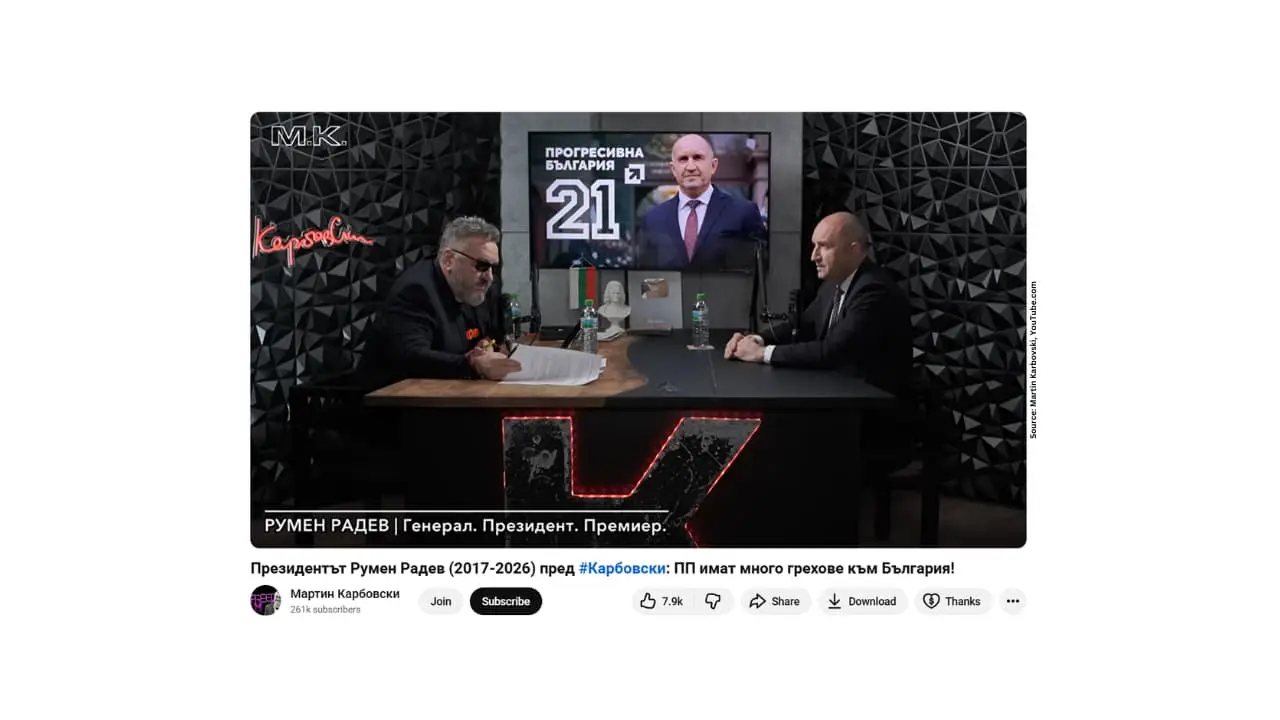
The former Bulgarian president and prime minister hopeful Rumen Radev, finally speaks to the masses, pitching his platform in a YouTube podcast. Although he is running on an anti-oligarchy platform, his focus shifts to the East, and he spreads messages that must definitely be noted by Bulgaria’s geopolitical partners.
The Messiah – every few years a person comes up in Bulgarian politics, a person that looks like a promise, a person that people suddenly start to believe in as they think “he is different” and “he will be the one! The one who will end corruption! The one who will send the greedy oligarchs to prison! The one that will make us all rich and happy!… Or at least the one that will steal less than the rest.” History shows that none of the previous “messiahs” has ever matched the expectations people had invested in them.
Rumen Radev was the president of Bulgaria for 9 years – from 2017 to 2026, when he resigned in order to enter the battle to become the next prime minister of the country. Shortly after, the political coalition “Progressive Bulgaria” became his party.
Currently all sociological research is predicting “Progressive Bulgaria” with significantly higher numbers compared to the second and third in the race.


Why does this interview matter?
Rumen Radev goes around the country and speaks in halls in front of the public, however, he is yet to appear in a national media where he could be questioned by a journalist. Further to that, there are reports that he refused face-to-face leader debate stating that he does not want to get into a debate with people who are spreading lies against him.
Rumen Radev finally appeared in a formal interview on YouTube, sitting against the openly pro-Russian journalist Martin Karbovski.
While Karbovski’s rise to fame was thanks to his crude presentations of the real-life stories of people, who the society would treat as outcasts, a few years ago he moved his production online, supporting himself through Patreon. Here is some of Karbovski’s online presence in the last few years since the war in Ukraine started:


Radev is one of many politicians sitting with Kaborbovski, but the significance of this interview is in the fact that this was the first and so far, the only formal appearance in a major media platform of the former president of Bulgaria during the parliamentary election campaign.
Focus
Radev is running on an anti-corruption and anti-oligarchy platform, knowing that Bulgarians are tired of the seemingly endless cycle of parliamentary elections in the last 4 years that further eroded the trust in the official institutions. However, during the 1 hour and 24 minutes Raved spoke with Karbovski, he never laid down a plan of how he will combat the wide-spread corruption or how he will seek to stop the practices that make Bulgarian oligarchs richer and more powerful at the expense of ordinary Bulgarian citizens.
Instead, another topic took significant prevalence in the conversation – geopolitics. The overall conclusion from the interview was that all geopolitical routes in front of Bulgaria and Europe seem to lead to Russia.
The word “Russia” was mentioned 16 times, more than half the time the word “Bulgaria” was used (30 times).

Here are some major points Radev did during the interview:
“We, under all circumstances, must renew the dialog with Russia.”
On the question of using Russian gas: “[Russian] gas is only bad for ideological reasons. […] The EU, and Bulgaria, have to choose whether to develop an ideology or to develop an economy. This is very hard, especially when ideology is detached from reality.”
“[You must have boots on the ground,] this is why the illusion that constantly flowing weapons towards Ukraine will somehow help Ukraine, ends there.”
“Bulgaria is the only Slavic and Eastern Orthodox EU member state, and this needs to be used, and we can really be a very important cog in this machine that, I am certain, will sooner or later start working, to re-establish relations with Russia. Because, in a purely geographical, economical, resource and market sense, we must re-establish relations [with Russia].”
Radev claimed that other political subjects are going above and beyond helping Ukraine, following EU policy, which threatens Bulgarian sovereignty, and he will seek to “end such sinful practices”.
“The circumstances will force Europe, if it wants to be a factor on the geopolitical scene, to return to the fastest and cheapest, and most logical source of energy material – this naturally is Russia.”
“The most astonishing phenomenon, when we are speaking about these people [people blaming Euro-sceptics for Putinists], that when you think about the national interest, you are suggesting nationally-responsible solutions that relate to the future of Bulgaria, the first thing to be said is “Putin” – this is the big problem of our days.”
“The tendency [in the petrol and diesel prices] is clear. The tendency is outlined by geopolitics, the tendency is outlined by our participation and position in said geopolitics; by the slavery, I can say, not that expedient ideologies, which are after times refused by their own creators. However, the defeats are hard to be fixed. […] (A question asked about which ideologies Radev was referring to.) I can’t say it’s only liberalism, let’s say – the Green Deal; let’s say – the sanctions against Russia. But, when I say “sanctions against Russian”, we shall have in mind that when you are imposing sanctions, you must think a few steps ahead of the possible reaction amongst the whole geopolitical environment. For example, when you sanction Russia, but you have not prepared the soil (meaning: laid down the fundamentals) with diplomatic demarches with the countries of the Global South. What happens next is that the Russian petrol just goes there, the money is still flowing to Russia, but we suffer and we see (points towards a photo showing the current petrol prices in Bulgaria) the thing that you are showing in this picture.”
Probably none of this comes as a surprise, considering in November 2021, during a presidential debate, Radev expressed that “the sanctions [against Russia] are obviously not helping”, that “Russia is an important factor in the fight against terrorism”, and exclaimed that “Crimea is Russian, what else could it be?”
While Radev mentions the war in Ukraine, he doesn’t say anything about the reason why there is a war in Ukraine and how it was started.
Domestic Politics
While there wasn’t a lot said about this part of the manifesto of “Progressive Bulgaria”, Radev made it clear he is in favour for every Bulgarian student to learn how to shoot with a gun, equating military preparation lessons with lessons in patriotism.
When asked by Karbovski regarding his opinion of the “foreign agents law” (a law introduced in Russia to suppress independent media), Radev said that “it must be clear who is being financed from where and the obligations they are taking on, here, in Bulgaria”, which sounds like the justification used by Putin’s government to introduce this law and it expansions. At the same time, Radev pointed out how much we need “freedom of speech” in Europe.

According to the latest research by the sociology agency Alpha Research, Bulgarians are still mostly pro-European Union. There have been quite a few critical comments on Facebook under the post containing the link for the interview. Still, there is no indication of Radev’s numbers declining.
Leave a Reply