
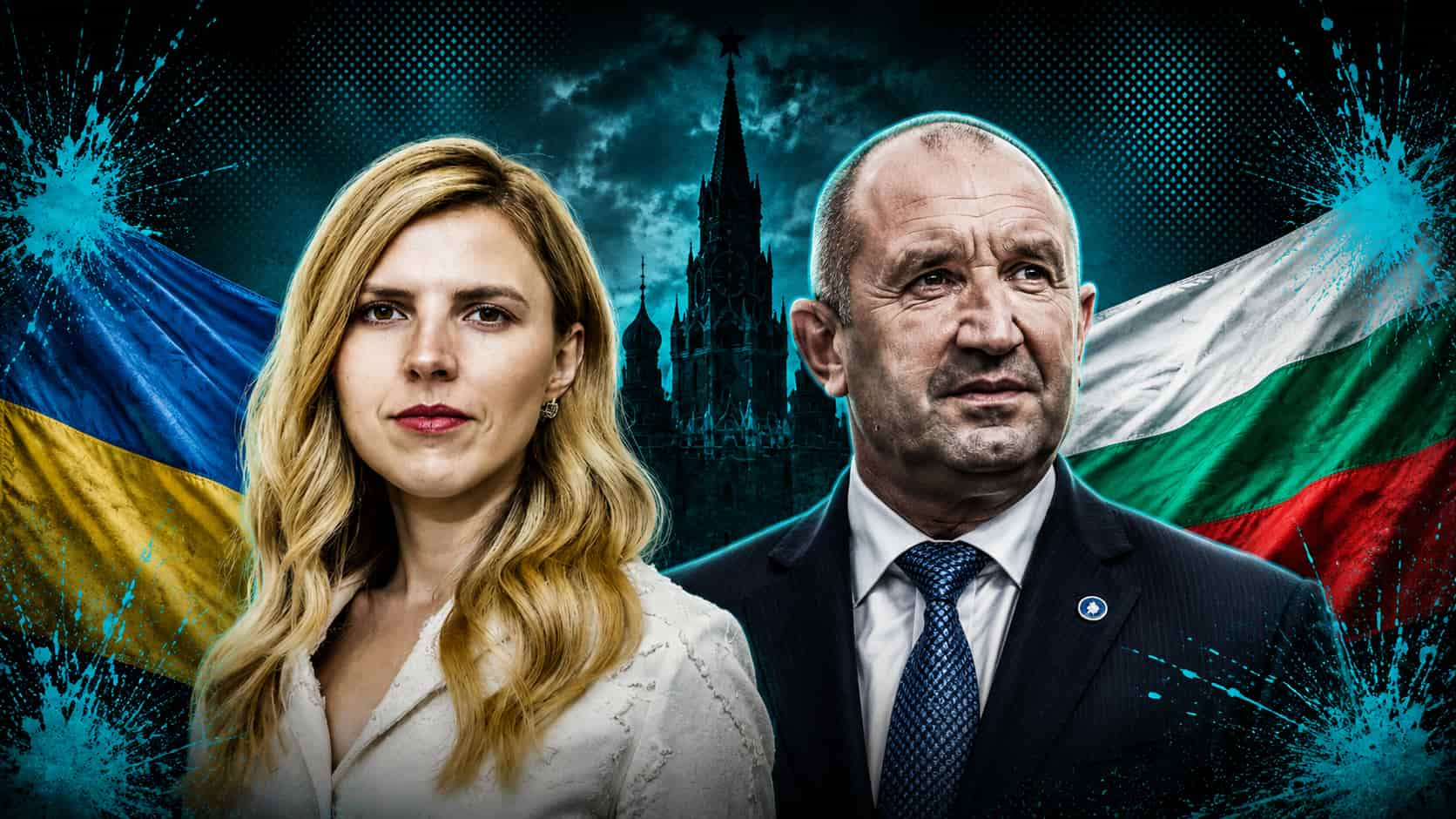
While Bulgarian Prime Minister Rumen Radev completely denied that his Foreign Minister, Petrova-Chamova, had anything to do with the Kyiv Declaration (despite her name still appearing among those endorsing it), Bulgaria’s international partners began voicing growing frustration with the country’s foreign policy conduct.
The day after news of the Kyiv Declaration shook the government, Prime Minister Rumen Radev challenged journalists by asking: “Did you actually see Minister Petrova[-Chamova]’s signature on that declaration?” In reality, none of the politicians supporting the declaration physically signed it because, as Chamova herself explained, “Declarations of this kind are not signed.” She also acknowledged that, in Ukraine’s view, “attendance itself demonstrates support.”
Chamova was quick to stress that the declaration “is not something that commits us” and added: “When something does not commit us, but allows our partners to fulfil the commitments they wish to undertake, that does not create any problem for us.”
According to Radev, however, Chamova was in Kyiv merely as a guest for Ukraine’s national day because he himself was unable to attend. He reaffirmed his position that Chamova had nothing to do with the declaration, even though her name still appears among its supporters on the website of the Ukrainian President.
Radev also insisted that “there is absolutely no disagreement within the government regarding the war in Ukraine,” saying that he had already made Bulgaria’s position clear in Brussels (before the EU), Ankara (before NATO), and Paris (before the Coalition of the Willing). According to him:
“Bulgaria is part of the common European decisions, but Bulgaria will not provide, and is not providing, weapons or financial assistance [to Ukraine].”
Radev then once again repeated talking points commonly associated with Kremlin propaganda, portraying Russia as an unbeatable military power that the West should fear—and therefore accommodate—if it wishes to avoid a nuclear strike:
“Every day we see the escalation growing, and we may witness […] a tactical nuclear strike!”
Chamova, meanwhile, when pressed by journalists, stated that Russia was the country that started the war. Regarding Ukraine, she said Bulgaria could provide support in the energy sector.
Chamova described the controversy surrounding the Kyiv Declaration as “a storm in a teacup,” arguing that it was intended to distract attention from the fact that “on Monday we clearly demonstrated that Bulgaria can defend its national interest while at the same time not becoming isolated.” She added that Bulgaria was finally “no longer blindly following instructions from other embassies” and urged:
“Each of us should focus on what Bulgaria can do at this moment to protect its national interest while at the same time being useful, so that the EU as a whole can play an active role” in the peace negotiations between Russia and Ukraine.
Radev and his party, Progressive Bulgaria, however, appear to have adopted a rather unusual approach to being “useful” to their international partners. They held up the European Union and helped shield three Russian oligarchs from sanctions, presenting it as a national victory. Recently, Radev used NATO’s platform in Ankara to repeat Kremlin talking points. These actions are already beginning to affect Bulgaria’s international reputation.
Here is what Latvian Prime Minister Andris Kulbergs told Reuters:
“Kulbergs was critical of EU nations such as Bulgaria which are blocking a 21st package of sanctions on Russia, which could place restrictions on 250 individuals and entities and tighten restrictions on Russian liquefied natural gas (LNG).
Leave a Reply