
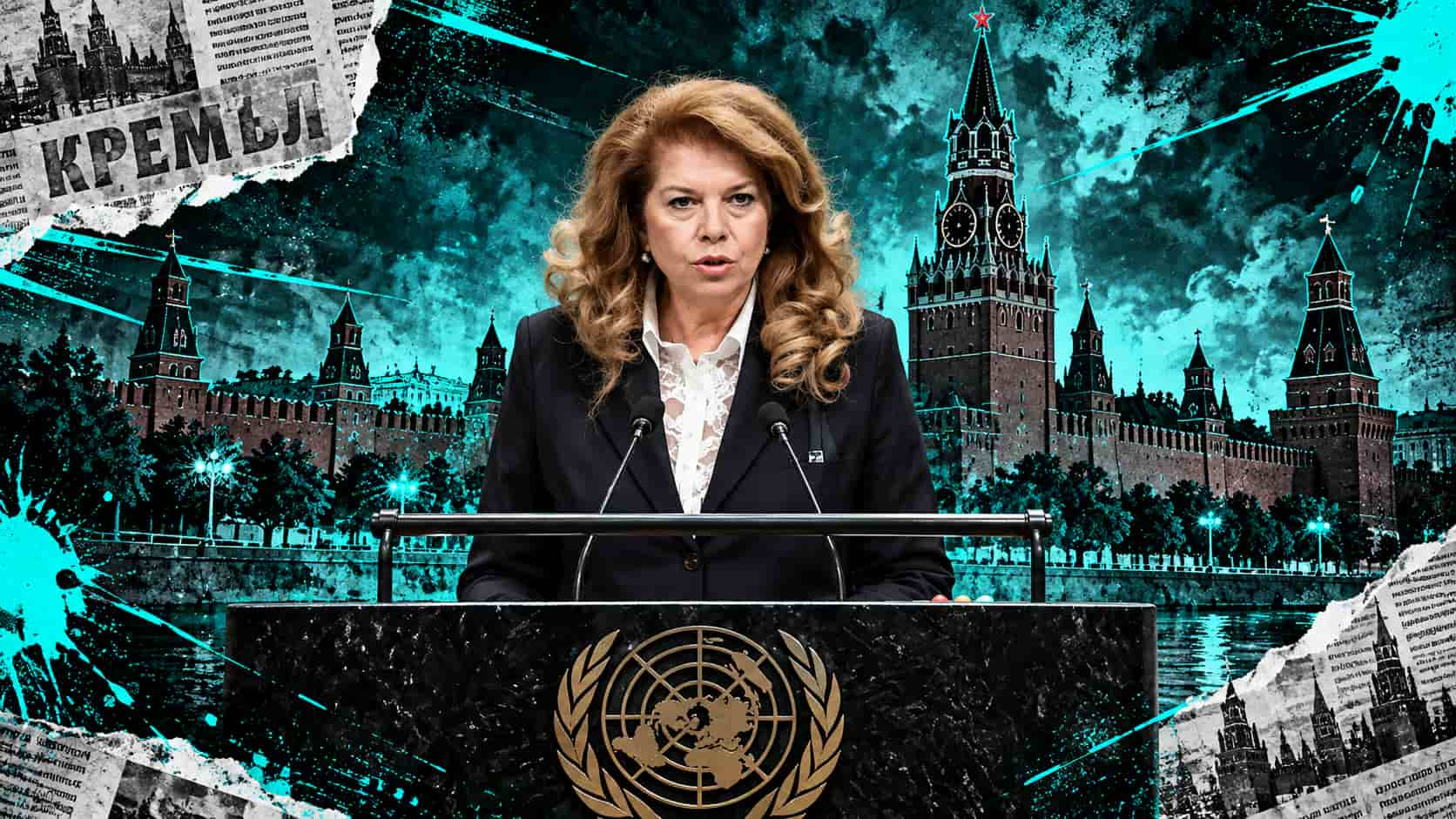
Address in French
On 23rd September 2026, Iliyana Yotova – the current Bulgarian President, addressed the United Nations General Assembly. She called for a diplomatic solution to the war in Ukraine. It was not her words that caused issues for her in Bulgaria – it was the fact she spoke in French. While French is one of the 6 official UN languages, nations’ leaders can opt in to speak in their own language. Many think that Yotova was a hypocrite for choosing French over Bulgarian for her speech.
Iliyana Yotova was a vice-president for Rumen Radev for 9 years. When Radev left the Presidency to become a Prime Minister of Bulgaria, Yotova stepped up and took his place. She is now running to become a President of Bulgaria for the next 5 years. Yotova is backed by Radev’s party Progressive Bulgaria and the Bulgarian Socialist Party (the continuation of the Bulgarian Communist Party).
When she announced her candidacy formally, Yotova spent a considerable amount of time talking about Russia, including making the following statement:
“Bulgaria must […] participate in diplomatic channels, including with Russia, which, I am convinced, will soon be opened.”
Yotova refused to call out Russia for being the aggressor and even when as far as to say that “the war in Ukraine has no military solution – more weapons and billions poured into it bring only more casualties and put Orthodox nations against one another”, which clearly indicates she is against support for Ukraine.
Iliyana Yotova has declared saving the Cyrillic alphabet as one of the pillars in her campaign. She initially claimed that her political opponents said that the Cyrillic is “distancing us [Bulgarians] from the civilised world”, but when journalists questioned her who and when said that, Yotova ran away to avoid answering. Later, in an interview, she said that she prefers to speak with the person who said it first before she announces their name. No name has been announced and no public information is available to back her claim.
All this considered, when Yotova addressed the UN in French, many Bulgarian saw hypocrisy in the fact she was not using the Cyrillic alphabet she claims she is on a quest to safe.
Bulgaria supports the joint declaration
On the same day as Yotova’s address, the Ukrainian Foreign Ministry published a joint declaration reaffirming the UN Security Council’s commitment to support the country. The declaration includes the following statements:
“We stand in solidarity with Ukraine as it continues to face Russia’s war of aggression.”
“We are deeply concerned by Russia’s escalation against civilians and civilian infrastructure across Ukraine causing record high number of casualties in the last months, as recorded by the UN. We call for full respect for international humanitarian law, accountability and for the protection of civilians.”
“Ukraine wants peace. We want peace. Russia must stop its aggression, accept a ceasefire, and engage meaningfully in negotiations towards a comprehensive, just and lasting peace in accordance with international law.”
All of the above are statements that Yotova and Radev would never back, as they follow a pro-Kremlin rhetoric and refuse to brand Russia as the aggressor. Therefore, the name of Bulgaria being amongst the countries backing the declaration caused shockwaves amongst politically aware Bulgarians and reminded them of a similar situation just months ago when Rumen Radev took the country out of the Coalition of the Willing, while the Foreign Minister Velislava Chamova backed another declaration in support of Ukraine.

Yotova claims she was blindsided by the UN
On 24th September Yotova published the following statement on her official Facebook page:
“Regarding the information published about a joint statement allegedly signed by me following the UN Security Council’s high-level meeting, I feel obliged to clarify the situation.
First, this statement was not signed. It was circulated to all Member States ahead of the session in New York. The Bulgarian state had no opportunity to express reservations concerning the position presented, nor were its proposed amendments accepted. For this reason, I did not attend the Council’s high-level meeting, as is evident from my absence from the group photograph taken afterwards.
I stated my position in my address before the UN General Assembly. There is no military solution for Ukraine. Peace cannot be achieved without the participation of Ukraine and Russia.”

Based on her statement, it could be concluded that Bulgaria was ambushed by the rest of UN and the declaration was forcefully imposed, while the statements in it are something Yotova and the Bulgarian delegation oppose. It reinforces the Kremlin narrative for the aggressive West that employs underhanded practices to harm Russia.
Progressive Bulgaria denies the declaration’s existence
Yotova’s statement added even more controversy to the matter and the political party of Rumen Radev, got involved into a crisis PR action. A press briefing was called on 25th September and one of the prominent representatives of Progressive Bulgaria – Anton Kutev, stated that: “In reality there is no declaration!”
He then asked one of his colleagues to read in Bulgarian part of Yotova’s address to further reaffirm that Bulgaria has nothing to do with the declaration in support for Ukraine and the only thing that matters is Yotova’s own speech at the Assembly.
Almost simultaneously, a Facebook page claiming to be the official Progressive Bulgaria social media page came out with a formal statement of support for the declaration:
“Thank you to Ukraine for its high appreciation of Bulgarian diplomacy.
Today, Bulgaria joined the joint declaration of 51 UN Member States, through which we called for a full, immediate and unconditional ceasefire in Ukraine and the beginning of meaningful peace negotiations.
We thank Ukraine for its kind words. For us, solidarity, international law and the pursuit of peace are a shared responsibility.”

This caused even further confusion. The page’s branding and name are consistent with those of Progressive Bulgaria and the content they have posted so far is based on official statements of Rumen Radev and other party members.
Progressive Bulgaria denies ties with the Facebook page
On 26th September, the Bulgarian outlet Sega.bg came out with the news that Progressive Bulgaria claim they have no ties with the Facebook page of Progressive Bulgaria. The page was created in March 2026, around the time the party was formed, and has since published official information supporting Rumen Radev and his fellow party members. It is branded in the party’s colours and regularly posts quotations from its members.
When it was first created, the page used AI-generated images similar to those used by Facebook groups that changed their identities to support Radev during the election campaign. The points out to a possibility that even if it is not directly controlled by Progressive Bulgaria, the page may be part of the party’s PR operations.

Yotova belittles the declaration but refuses to pull out of it
On 27th September 2026, speaking to journalists Yotova reaffirmed that the only thing that matters for Bulgaria’s position on the war in Ukraine is the address she made to the UNGA, not the declaration of support. She repeated that “there can’t be a military solution” to the war. Yotova took pride in how well her speech was received.
She pointed out that the UN declaration “is not a declaration, not a UN document” and it has nothing to do with the Security Council – all claims are in direct contradiction with the text of the document. The Bulgarian President said that this is just a “statement of 40 countries regarding the war in Ukraine”. She said that Bulgaria will not pull out of the declaration.
Comment
This is a confusing rollercoaster of events that gives out the lack of professionalism and political thinking of the current Bulgarian government. Furthermore, it makes the country look unreliable in geopolitical sense – a state ready to put the blame on their own partners to remain in the Kremlin’s good books.
The only thing that remains consistent throughout is the effort of the Bulgarian government and President to distance themselves from the “West” to remain loyal in the eyes of Moscow. The question is why. Why is it such a big problem for the governing elite in Bulgaria to voice support for Ukraine, be it only on paper? What do they lose from standing with the rest of the Western world? Or probably we should ask what do they win? And most importantly – who gives them the prices?
Leave a Reply